
Resource Library
CASE STUDY: Beach Terrace, Mooloolaba: 45% Less Congestion Delay After Dynamic Route Guidance
By Simon Maselli
- Case Study
- Sunshine Coast Council
- Congestion
- Route Guidance
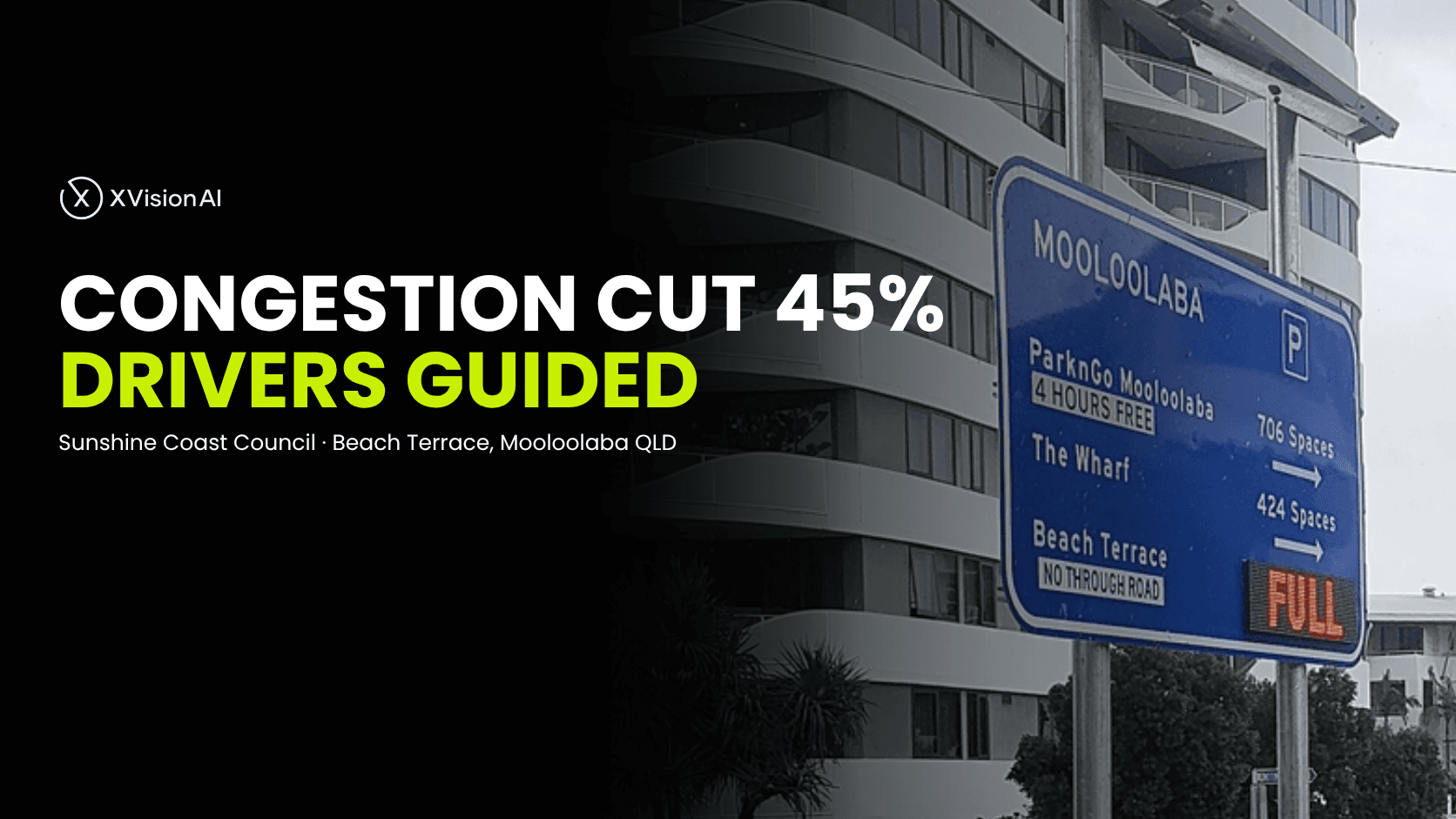
Sunshine Coast Council | Beach Terrace, Mooloolaba, Queensland | 2025
The Outcome
Total congestion delay fell from 2,247 minutes in July 2025 to 1,229 minutes in August 2025.
August 2025 was the month immediately after installation.
That is a 45% reduction in aggregate congestion delay on the Beach Terrace approach.
Drivers now get an early, reliable cue to divert to alternative parking when congestion is detected. That cue reduces queueing.
The Challenge
Congestion regularly built up as drivers turned into Beach Terrace from the state road to the north.
Council expected construction works to close Beach Terrace to through traffic. That would make the problem worse.
Council needed a clear, real-time signal for drivers. The signal had to tell them to take an alternative route or move into the right lane early. It had to reach them before they committed to the congested approach.
Key constraints:
- A standalone system with no involvement from council operations or IT networking. It is a fully managed service.
- No data storage or licence-plate capture required.
The Solution
XVision deployed a solar-powered XVision EagleEye unit. It has onboard edge processing and connects via cellular.
The EagleEye calculates congestion in real time. It sends congestion levels to a roadside variable message sign (VMS). The sign switches states automatically.
When congestion is detected, the sign shows a "FULL" indicator. It directs drivers to alternative parking:
- ParknGo Mooloolaba (706 spaces)
- The Wharf (424 spaces)
- Beach Terrace marked as "NO THROUGH ROAD"
The sign sits near the previous trailer sign location.
The EagleEye sits upstream of the last practical diversion point on Mooloolaba Esplanade.
Technical Approach
- Edge sensing: An XVision EagleEye industrial unit detects congestion on-device.
- Power: A solar panel and battery on a tilt-down pole. Fully self-contained.
- Signage: A solar LED variable message sign with digital messaging, updated over cellular. Built to relevant Queensland and Australian road standards.
- Connectivity: Cellular. Fully standalone. No council network required.
- Integration: Congestion levels from the XVision EagleEye drive automated switching of the sign states.
Delivery
Installation was completed in July 2025.
Local contractors delivered the civil works and electrical installation. Minnovation delivered the edge configuration and system integration.
The service commitment includes:
- High uptime
- Rapid response
- Quarterly maintenance
- Continuous remote monitoring
- Accuracy validation against manual counts
Summary
Standalone XVision EagleEye edge-AI sensing and dynamic roadside guidance cut approach congestion. Council infrastructure and ongoing operational involvement are not required.
Got an approach that keeps backing up?
Tell us about the location. We'll show you what the data says and how early driver guidance could cut the delay, without touching your network.